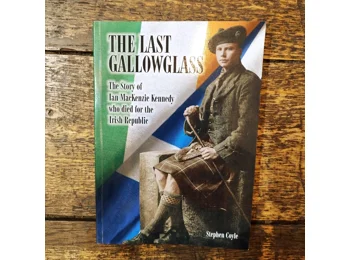
THE LAST GALLOWGLASS: The Story of Ian MacKenzie Kennedy who died for the Irish Republic
Product Code: 9781806056934
Rating: Be the first to write a review
Weight: 200.0g
Product Condition: New
THE LAST GALLOWGLASS: The Story of Ian MacKenzie Kennedy who died for the Irish Republic By Stephen Coyle
Book Review By Gerry Cairns
When we think of a kilted soldier, we will almost definitely think of someone very different from
Ian MacKenzie Kennedy. He may have had, at times, a feather in his bunnet and a kilt upon his
knee, but MacKenzie Kennedy was no representation of the clichéd Scottish martial spirit. He
was from early 1918 a soldier in the Irish Republican Army.
This unique figure is the subject of a new book by Stephen Coyle. Coyle is a well-respected
historian of the Irish community in Scotland. Yet his subject, known as ‘Scottie’, was not of the
Irish community and has turned out to be part of a 34-year labour of love for the author in
bringing out this obscure Scotsman and showing the part he played in the fight for Irish
freedom. The material was neither voluminous nor obvious. Coyle has produced a fine work,
diligently researched and empathically written.
In no way does MacKenzie Kennedy fit the stereotype of an IRA volunteer. He was born in
West Bengal, India in 1899 in the days of the Raj. His father was a British soldier. His first
experience of Scotland was in his education. Scotland was chosen due to ancestral connections.
Coyle points out that this was common for the sons of British soldiers in India. A fascinating
tale, in words and pictures emerges of MacKenzie Kennedy’s personal journey and political
development with the help of his politically aware mother, Sara. An early figure in the first Scots
Renaissance, Patrick Geddes, also makes a cameo appearance. After the death of his father in
1914 in England, Sara took the family to live in Scotland in 1916. Young Ian embraced the
culture, language and identity.
He would visit County Kerry in 1917, on holiday with his mother, and would embrace the same
things in an Irish context. It would appear that Sara took Ian to Ireland to avoid being
conscripted in the British Army while the war still raged in Europe. His journey would take him
from Kerry to the Irish language college at Ballingeary in County Cork, and this would prove to
be a significant venue as the War of Independence unfolded at the end of the World War.
Sometime at the beginning of 1918, Scottie joined an Irish speaking company (no. 4) of the IRA
in Ballingeary. He was popular in the area, “noted for his talented playing of bagpipes, wearing
the family tartan plaid and Glengarry cap with the Kennedy clan badge. This attire was soon to
be replaced by the uniform of a Republican soldier.” (p. 32)
From this point, the book really comes into its own. Coyle powerfully tells the tale of MacKenzie
Kennedy’s involvement in the War of Independence, and his support for the Republican side in
the Civil War. The tone is balanced, almost dispassionate, yet measured and illuminating. Indeed,
Coyle seems to come into his own when telling the tale of the battle at Douglas (or Rochestown)
in August 1922. This battle resulted in Scottie’s untimely death at the hands of Free State forces.
Coyle vividly describes the events with context and a fine eye for detail.
History has a way of burying its protagonists. That is the fault of historians. Certain historians,
like Stephen Coyle, wish to save the memory of some key players in history. He is to be
commended for it. Coyle’s choice of title is redolent of an age when Scots and Irish clans (the
Gallowglass) fought the same fight. The photographs show a young, handsome Scotsman. At
other times they show an Irish volunteer. Just one young man, two ancient nations. Both
Scotland and Ireland should remember him.
Book Review By Gerry Cairns
When we think of a kilted soldier, we will almost definitely think of someone very different from
Ian MacKenzie Kennedy. He may have had, at times, a feather in his bunnet and a kilt upon his
knee, but MacKenzie Kennedy was no representation of the clichéd Scottish martial spirit. He
was from early 1918 a soldier in the Irish Republican Army.
This unique figure is the subject of a new book by Stephen Coyle. Coyle is a well-respected
historian of the Irish community in Scotland. Yet his subject, known as ‘Scottie’, was not of the
Irish community and has turned out to be part of a 34-year labour of love for the author in
bringing out this obscure Scotsman and showing the part he played in the fight for Irish
freedom. The material was neither voluminous nor obvious. Coyle has produced a fine work,
diligently researched and empathically written.
In no way does MacKenzie Kennedy fit the stereotype of an IRA volunteer. He was born in
West Bengal, India in 1899 in the days of the Raj. His father was a British soldier. His first
experience of Scotland was in his education. Scotland was chosen due to ancestral connections.
Coyle points out that this was common for the sons of British soldiers in India. A fascinating
tale, in words and pictures emerges of MacKenzie Kennedy’s personal journey and political
development with the help of his politically aware mother, Sara. An early figure in the first Scots
Renaissance, Patrick Geddes, also makes a cameo appearance. After the death of his father in
1914 in England, Sara took the family to live in Scotland in 1916. Young Ian embraced the
culture, language and identity.
He would visit County Kerry in 1917, on holiday with his mother, and would embrace the same
things in an Irish context. It would appear that Sara took Ian to Ireland to avoid being
conscripted in the British Army while the war still raged in Europe. His journey would take him
from Kerry to the Irish language college at Ballingeary in County Cork, and this would prove to
be a significant venue as the War of Independence unfolded at the end of the World War.
Sometime at the beginning of 1918, Scottie joined an Irish speaking company (no. 4) of the IRA
in Ballingeary. He was popular in the area, “noted for his talented playing of bagpipes, wearing
the family tartan plaid and Glengarry cap with the Kennedy clan badge. This attire was soon to
be replaced by the uniform of a Republican soldier.” (p. 32)
From this point, the book really comes into its own. Coyle powerfully tells the tale of MacKenzie
Kennedy’s involvement in the War of Independence, and his support for the Republican side in
the Civil War. The tone is balanced, almost dispassionate, yet measured and illuminating. Indeed,
Coyle seems to come into his own when telling the tale of the battle at Douglas (or Rochestown)
in August 1922. This battle resulted in Scottie’s untimely death at the hands of Free State forces.
Coyle vividly describes the events with context and a fine eye for detail.
History has a way of burying its protagonists. That is the fault of historians. Certain historians,
like Stephen Coyle, wish to save the memory of some key players in history. He is to be
commended for it. Coyle’s choice of title is redolent of an age when Scots and Irish clans (the
Gallowglass) fought the same fight. The photographs show a young, handsome Scotsman. At
other times they show an Irish volunteer. Just one young man, two ancient nations. Both
Scotland and Ireland should remember him.
€11.99 inc. tax
Customer Reviews
No Reviews Posted Yet - be the first! (write review)